


No Head in the Clouds: Survey Results Refute Stereotypes of Young People
In the run-up to Youth Day, IQ.HSE studied the results of an all-Russian survey by the Centre for Studies of Civil Society and the Nonprofit Sector. Sociologists studied the role of young people in charity and volunteering. What do they sacrifice for the sake of their neighbours — and are they prepared to do it in general? For those who think that young people have their heads in the clouds, the answers will be unexpected.

Returning to Life: How to Help 'Troubled' Teens Get a Fresh Start and Integrate into Society
Some children who don’t go to school and commit crimes manage to reintegrate into society by learning new mores and lifestyles. But others only appear to adapt, becoming ‘outsiders’ again the minute they leave the school grounds, going back to the same risky life on the streets. The two approaches offer youngsters very different opportunities in life. This IQ.HSE article, that draws on research by sociologist Irina Lisovskaya, explores how to help such youth integrate into society and learn to communicate with others.

Discussing ‘The Chair’ in the Context of Contemporary University Problems
At the end of December 2021, the Laboratory for Studies in Economic Sociology (LSES) at HSE University held its traditional Christmas Cinema Seminar entitled ‘Where are universities going?’ Participants discussed ‘The Chair’, a TV series created by David Benioff and Daniel Brett Weiss, authors of ‘Game of Thrones’. 2021 marked the 20th anniversary of the Christmas seminar, which LSES has held to discuss hot-button issues after watching famous Russian and foreign films.
'I Took Up a Blue-collar Job to Do My Research'
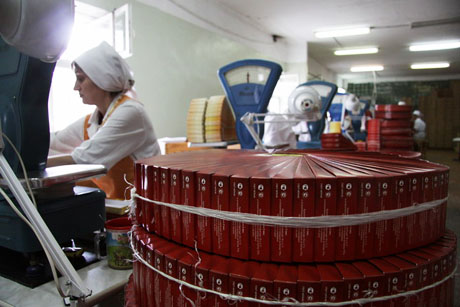
Olga Pinchuk shares the personal experiences that have informed her academic research, explains why manual labour is still prevalent in Russia, and examines widespread stereotypes about blue-collar workers.

Research Shows That Creative Workers Are Motivated by Money and Social Guarantees More Than Artistry
Creators are also part of the job sector. Their work is increasingly oriented around commercial activities and in the pursuit of economic goals. As such, the organization of artists’ professional work and the motivations behind it are by no means unique. Rather, they straddle the line between ‘aesthetic’ and ‘market’ concerns.

Online Platforms Force Russian Freelancers to Work Nights And Weekends
To get work in a highly competitive environment, freelancers adapt their own routines to the needs of their clients, so they have to work long hours not only during the day but also during non-standard hours, obeying the unwritten laws of online platforms.

The Trauma of Chernobyl: Why Our Collective Memory of Disasters Tends to Fade with Time
This year marks the 35th anniversary of the Chernobyl disaster. The event recedes ever further into the past, but the legacy of the trauma it caused endures. That stress produced trauma, and the trauma became part of Russia’s collective memory. Sociologists Yulia Belova, Margarita Muravitskaya and Nadezhda Melnikova of HSE’s Institute for Applied Political Research and Laboratory for Studies in Economic Sociology researched what this means for people who lived in the radioactively contaminated zone around the reactor and why the collective memory of the accident might disappear.

Russian IT Freelancers Face Gender Discrimination
Olga Vilkova, a PhD student of the HSE University's Faculty of Social Sciences, has proved that IT engineers face inequality and discrimination on the Russian online freelance market—websites offering jobs for self-employed people. The researcher analyzed the data on professional success of 54,000 IT engineers registered on the major Russian freelancing platform FL.ru. The research is published in the Monitoring of Public Opinion: Economic and Social Changes Journal.

Mothers of Three and More Children Face Career Struggles
Well-educated women having three or more children often try to return to work after maternity leave but face penalties for motherhood and 'overqualification', as potential employers offer them lower paid, lower-ranking jobs and treat them as second-rate employees. Some mothers of many children choose to leave the labour market altogether. A paper by Zlata Dorofeeva, Research Fellow of the HSE Institute for Social Policy's Centre for Longitudinal Studies, offers an insight into the career struggles faced by mothers of many children in Russia.

Twelve Trends Among Contemporary Russian Women
Every year, HSE University carries out dozens of studies on women’s lifestyles, behaviours, and changes in family, social, and economic status in Russia. IQ.HSE editors have selected the most essential trends revealed by these studies about Russian women today.